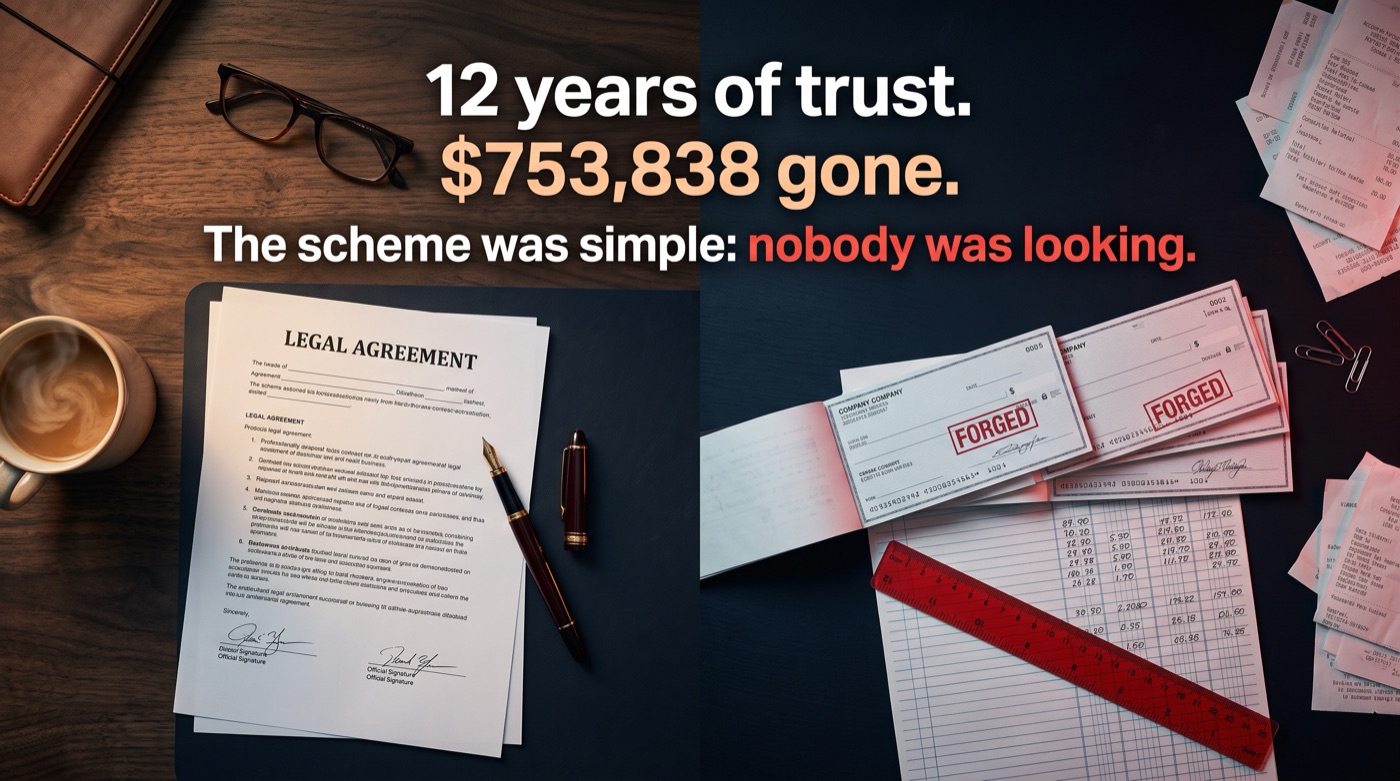
On September 1, 2026, Heather Murdock, 58, of Ellington, Connecticut, pleaded guilty in federal court in New Haven to one count of bank fraud and one count of tax evasion. She was the bookkeeper and office manager at a Hartford law firm, identified in court documents only as "Firm A."
Between approximately 2010 and 2022, Murdock used the firm's bookkeeping software to generate hundreds of false checks payable to herself, forged the owner's signature on them, and deposited them into her own bank account. She then edited the bookkeeping entries so the checks appeared to have gone to legitimate vendors. That scheme took about $578,279. She also kept about $175,559 in cash rent paid by tenants of properties the firm's owner held, and hid the shortfall by writing false checks from the firm's account into the owner's rental income account so the expected deposits appeared. She underreported her income for 2011 and 2012 and filed no federal returns for 2013 through 2022, a tax loss of $225,991. She agreed to pay $753,838.70 in restitution, and sentencing is set for December 1, 2026. The FBI and IRS Criminal Investigation investigated.
Under the ACFE Fraud Tree: asset misappropriation, two schemes run side by side. Check tampering with a forged maker's signature, concealed by falsified disbursement records, and skimming of rent receipts, concealed with fraudulent checks drawn on the firm.
When owners think of business fraud, they picture sophisticated cyber intrusions or complex offshore shell companies. In reality, the most destructive occupational theft is low-tech, slow, and carried out by the person who has the office keys and knows your kids' names.
A federal guilty plea in Connecticut shows how an unchecked back office can drain three quarters of a million dollars over roughly twelve years without anyone noticing.
Heather Murdock was the bookkeeper and office manager for a Hartford law firm for well over a decade. The firm's owner was doing what professional service owners are supposed to do: practicing law, meeting clients, and bringing in revenue. The books were left to Murdock. In practice, that meant one person controlled both the checks and the record of the checks.
That control let two separate schemes run side by side.
Forged checks, recorded as vendor payments. Using the firm's bookkeeping software, Murdock generated hundreds of checks payable to herself, forged the owner's signature, and deposited them into her own bank account. Then she edited the entries in the bookkeeping system so each check appeared to have gone to a legitimate vendor. About $578,279 left the firm this way.
Skimmed rent, covered with the firm's money. The owner also held rental properties, and tenants paid rent in cash. Murdock kept about $175,559 of it. To keep the owner from seeing the rent come up short, she wrote false checks from the law firm's account into the owner's rental income account, so the expected deposits showed up, and doctored the references in the books.
The detail that matters most is in the first scheme. The bank paid Heather Murdock. The books said the firm paid its vendors. Anyone reading the books saw an ordinary stream of vendor payments. The truth was on the cleared check images, and for twelve years nobody independent of the bookkeeper compared the two.
The rent cover-up has the same weakness. The owner's rental account showed deposits, but they came from the owner's own law firm, not from tenants.
Annual tax preparation and basic compilations are not designed to find fraud. An accountant preparing returns or compiling statements checks that the math ties out and that expenses land in the expected categories. When a bookkeeper records a forged check as a payment to a real vendor, the debits and credits balance perfectly.
Even a financial statement audit tests a sample of disbursements, not every one. Hundreds of forged checks spread across twelve years of ordinary operating volume, each one recorded to a vendor the firm really used, is exactly the pattern a sample is least likely to surface. And a sampled check traced only to the ledger passes, because the ledger is the thing she rewrote.
Separate the duties that let one person hide a check. Whoever prepares checks or enters bills should not sign them, and should not reconcile the bank account.
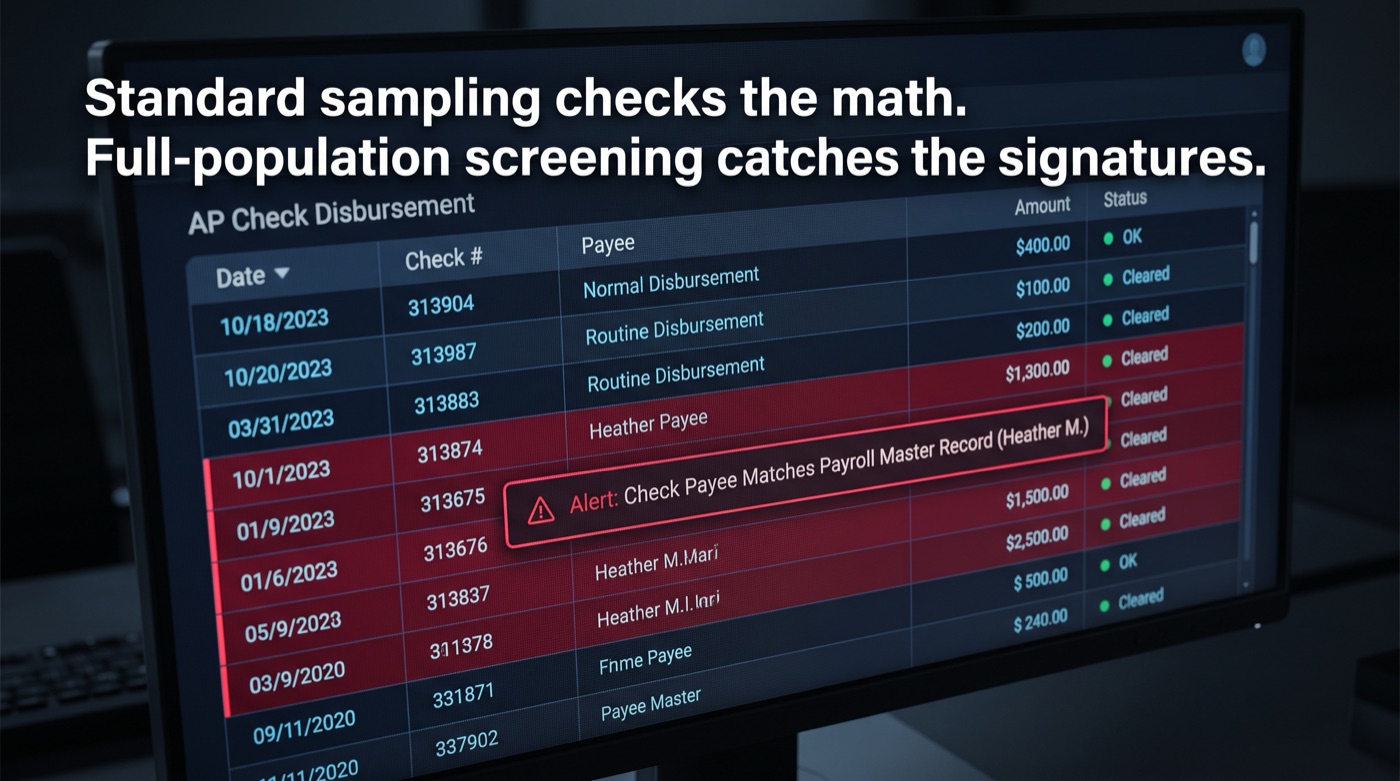
Read the cleared check images, not just the register. Whoever reconciles should compare the payee on each cleared check to the payee in the books. Here, every forged check would have shown the mismatch: a vendor in the ledger, the bookkeeper's own name on the check.
Match payees against employees, using the bank's records. Full-population screening that compares check payees and deposit accounts against the employee list flags any company check that lands with an employee. Run it on the bank side. Run on the ledger, it would have found nothing, because the ledger showed vendors.
Use payee positive pay, with someone else approving the list. Positive pay has the bank match each check's number, amount, and payee against a list the company uploads. It only protects you if the person who writes the checks is not the person who builds and approves that list.
Know where your deposits come from. Rental income should come from tenants. A check from the owner's own law firm landing in the rental account as rent is a red flag on sight. Moving tenants off cash, to traceable payments with receipts, removes the opportunity entirely.
None of this requires a forensic investigation. It requires someone other than the bookkeeper to look at the bank's version of events, across every transaction rather than a sample. That is the core of a Business Health Check, and it is the question worth asking if one trusted person has run your books for years: when did anyone last compare what the bank paid to what the books say?

I've spent 15+ years investigating financial crime in law enforcement, fintech, and the credit bureaus. I write these briefs so the patterns are harder to miss. If this one hits close to home, I'm easy to reach.