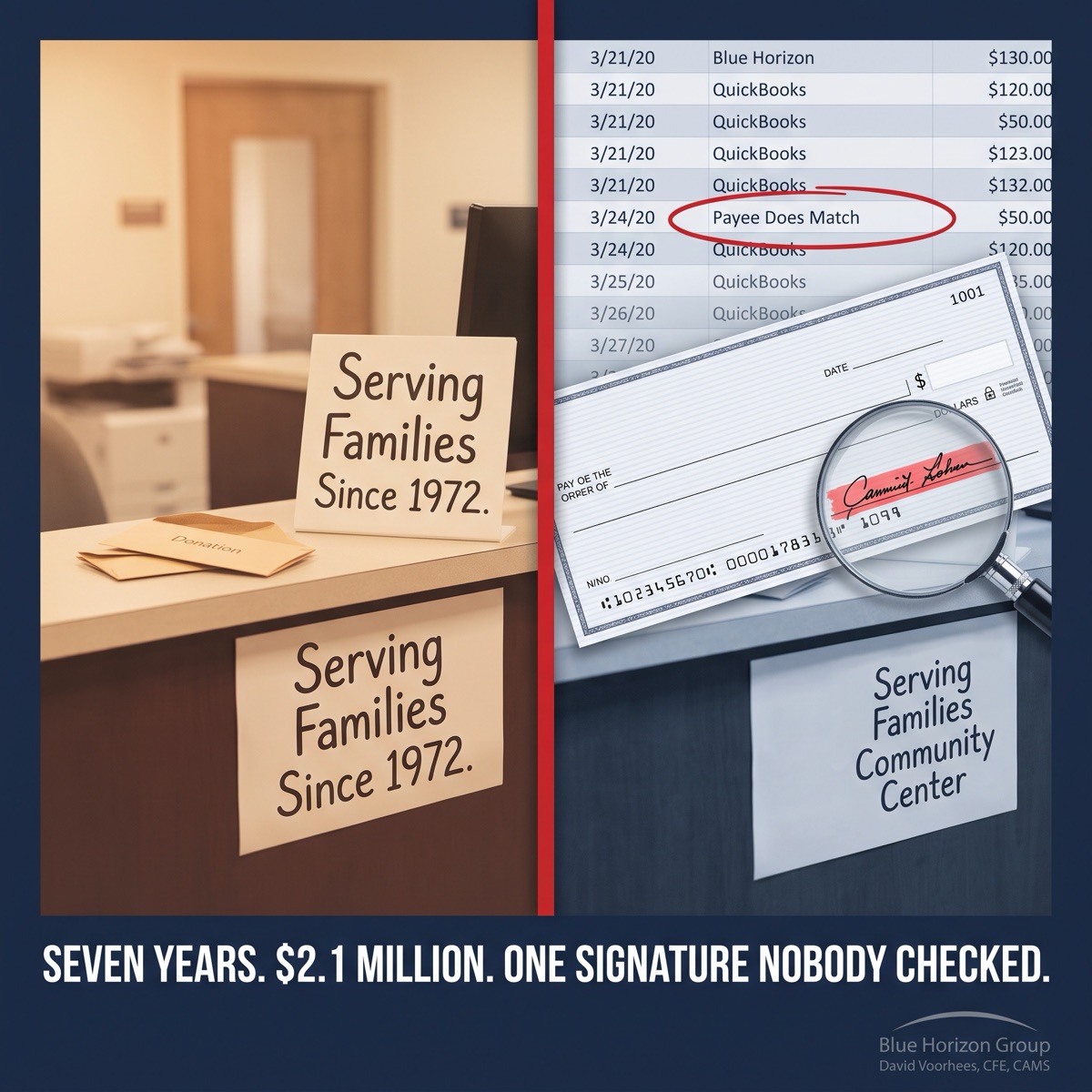
On August 26, 2026, Jeffrey Scott Keehn, 55, former Chief Financial Officer of the Child and Family Guidance Center, a Dallas charity providing mental health services to indigent populations, was sentenced to 60 months in federal prison, three years of supervised release, and full restitution of $2,109,786.56. He had pleaded guilty to wire fraud after admitting he stole that amount from the nonprofit over roughly seven years.
Keehn secretly accessed the charity's checkbook, forged signatures, and deposited fraudulent checks into his personal accounts, then falsified QuickBooks entries and misrepresented the charity's cash position to conceal it. The government seized roughly $800,000 in assets, including bank accounts, precious metals, a vehicle, and a condominium interest. At sentencing, the organization described not just the financial harm but the operational burden: forensic audits, years of reconstruction, and rebuilding funder trust.
Under the ACFE Fraud Tree: fraudulent disbursements via check tampering (forged maker method), concealed through false accounting entries, the perpetrator held both custody of the instrument and control of the record.
On August 26, a federal judge in Dallas sentenced Jeffrey Scott Keehn to five years in prison. Keehn was the Chief Financial Officer of the Child and Family Guidance Center, a charity that provides mental health services to people who cannot afford to pay for them. Over roughly seven years he took $2,109,786.56 from the organization.
The mechanics were not sophisticated. He got access to the checkbook. He forged signatures. He deposited the checks into accounts he controlled. Then he opened QuickBooks and made the ledger say something other than what had actually happened, and he told the people above him that the organization had more cash than it did.
That is the entire scheme. No offshore structure, no shell company network, no spoofed executive email. A person with custody of the instrument and control of the record simply used both.
Every nonprofit finance function rests on a division most organizations never articulate out loud. Someone moves the money. Someone else records what happened. Someone else confirms the two agree. When those three functions live in three heads, fraud requires collusion. When they live in one head, fraud requires only motive.
At small and mid-sized nonprofits, they almost always live in one head. Not through negligence. Through math. You have a finance staff of two, or one, or a part-time bookkeeper and an executive director who signs things between site visits. The CFO or controller is the person you hired precisely so you would not have to think about this. Handing them everything is the point of the hire.
Keehn's case is unusual only in the amount and the tenure. The pattern is the most common fraud pattern there is. The ACFE classifies it as asset misappropriation through fraudulent disbursement, specifically check tampering by the forged maker method, with a concealment layer of false accounting entries. It works because the concealment happens inside the same system everyone uses to check for problems.
The organization almost certainly had an independent audit during those seven years. Funders require it. The board expects it. And the audit did not catch this.
That is not a criticism of the auditors. A financial statement audit is designed to give reasonable assurance that the statements are free of material misstatement. It tests a sample, evaluates control design, and confirms balances. It is a well-built instrument for the question it is built to answer.
It is not built to answer the question a board actually loses sleep over, which is whether anyone is stealing right now and whether you would know.
A sample finds what is typical. A well-executed embezzlement is engineered to look typical. Individual checks below the review threshold, spread across time, posting to legitimate-looking vendors in the ledger. Any one of them survives inspection. The pattern only appears when you look at every transaction at once and compare what the bank says to what the ledger says.
The most instructive detail in the DOJ release is not the dollar figure. It is what the organization's representatives told the court at sentencing. They described the forensic audits they had to fund and the work of rebuilding after years of concealed losses.
That is the second loss, and for a mission-driven organization it is often worse than the first. Reconstructing seven years of manipulated records is expensive and slow, and it is paid for with money that was supposed to go to programs. Grant reports covering those years may need to be revisited. Funder relationships get a hard conversation. Staff who did nothing wrong spend months on remediation instead of the work they came to do.
The government seized roughly $800,000 in assets, so part of the money comes back. The institutional attention spent cleaning up does not.
There is a middle option between blind trust and treating your staff like suspects. Most nonprofit leaders do not know it exists because nobody sells it to them.
We call it a Business Health Check. It is a transaction-level review, not an audit and not an investigation. You export your accounting data and provide bank records. We run the entire population, not a sample, against known fraud typologies. For nonprofits specifically, that means testing for vendors that appear in your ledger and nowhere else in the world, including address matches against employee records. Payee mismatches, where the bank's electronic clearing data shows one recipient and your ledger shows another, which is the single test that would have surfaced the Keehn scheme. Restricted and grant funds disbursed outside their designation. Expense reimbursements that duplicate, inflate, or repeat on a pattern. Disbursements timed to weekends, holidays, and off-hours.
Nobody is interviewed. Program staff never know it happened. It runs off-site from exported data and takes days, not months. The output is a confidential executive summary that either tells you your controls are holding or points to specific transactions that deserve a closer look.
Most of the time it is the former. That is not a wasted engagement. A documented clean result is exactly what you want in hand when a funder asks how you safeguard restricted funds, or when a board member raises the question at a meeting.
You do not have to stop trusting your staff. You do have to be able to answer a specific question with something other than a feeling.
If a board member asked today whether $2,500 could be quietly diverted from your organization this month without anyone noticing, what would you say? If the honest answer is that you would probably catch it eventually, that is the gap.
Keehn's organization had that gap for seven years and $2.1 million.

I've spent 15+ years investigating financial crime in law enforcement, fintech, and the credit bureaus. I write these briefs so the patterns are harder to miss. If this one hits close to home, I'm easy to reach.