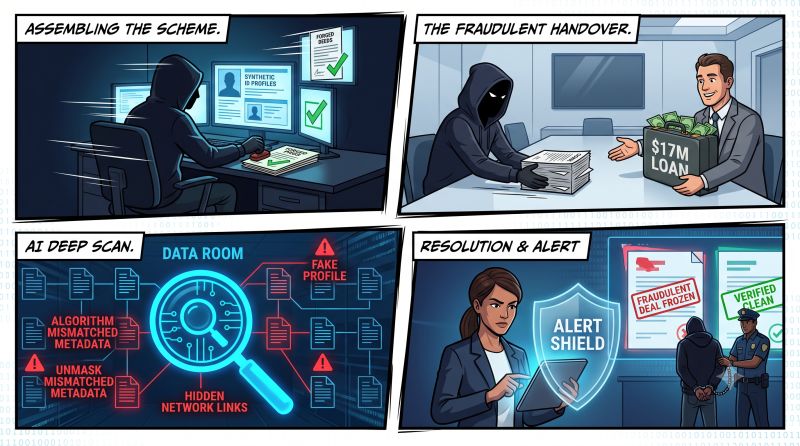
In early 2026, the U.S. Attorney's Office for the Central District of California unsealed a 15-count indictment, “Operation Hard Money”, charging 11 individuals, including two foreign nationals, with wire fraud, conspiracy, aggravated identity theft, and money laundering.
From January 2021 through May 2023, the ring stole the identities of elderly homeowners in Santa Monica, Hollywood, Westwood, and Chinatown, victims over 70 who owned properties outright, free of liens. Using stolen identity data, they obtained title reports, manufactured fake bank statements, rental agreements, doctors' notes, and even death certificates, then solicited roughly $17 million in hard money loans from private lenders by impersonating the owners and representing the loans as secured by the victims' properties.
The scheme combined synthetic documentation, identity impersonation, and cross-entity layering, precisely the fraud profile that document-by-document underwriting review fails to connect.
A $17 million private lending scheme collapsed after federal authorities dismantled a multi-state identity theft syndicate targeting private debt transactions.
Federal prosecutors charged 11 individuals in “Operation Hard Money” with wire fraud, conspiracy, and aggravated identity theft. The ring stole victim identities, manufactured fake bank accounts, forged title records, and impersonated owners to secure millions from private lenders. When standard underwriting checks verified property titles on paper, they failed to catch synthetic documentation and identity impersonation behind the loans.
This is where traditional due diligence hits a wall. Human analysts reviewing static PDFs or sample datasets often miss connected identity anomalies, or cross-entity relationship patterns hidden across thousands of deal documents.
Modern AI tools change the economics of fraud investigation. By deploying machine learning models, entity resolution algorithms, and computer vision across 100% of the documents you receive, deal teams can proactively spot red flags in minutes rather than weeks.
AI-driven forensic screening lets teams uncover synthetic identity signals and mismatched document data instantly, map hidden network relationships between borrowers, shell entities, and bank accounts, and shift from reactive post-closing damage control to real-time risk mitigation.

I've spent 15+ years investigating financial crime in law enforcement, fintech, and the credit bureaus. I write these briefs so the patterns are harder to miss. If this one hits close to home, I'm easy to reach.