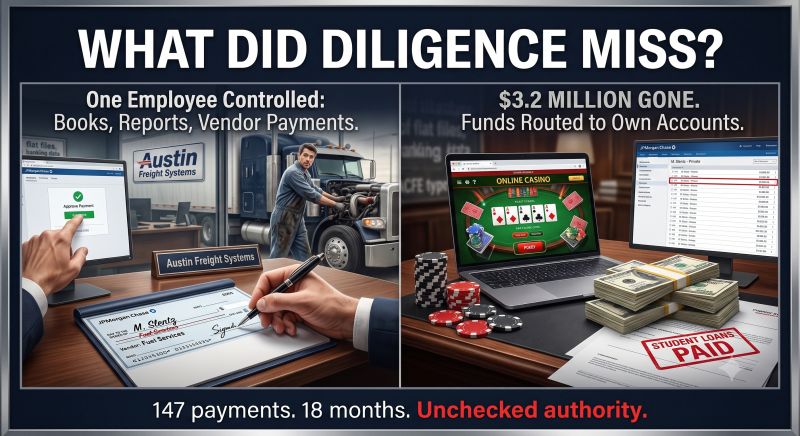
Mitchell David Slentz, 34, of Kyle, Texas, pleaded guilty in federal court in early July 2026 to wire fraud and engaging in monetary transactions with criminally derived proceeds, after embezzling more than $3.2 million from Austin Freight Systems.
As the company's financial controller, Slentz managed accounting operations, financial reporting, internal controls, and vendor payment requests submitted to JPMorgan Chase. Between October 2023 and March 2025 he executed 147 fraudulent payments totaling $3,277,937.35 into his own accounts, spending the proceeds on student loan payoffs and heavy online gambling. Every payment looked routine, because the person who would normally catch it was the person making it.
Under the ACFE Fraud Tree, this is a fraudulent disbursement scheme enabled by a complete segregation-of-duties failure.
One employee controlled the books, the financial reports, and the vendor payment approvals at Austin Freight Systems. For eighteen months, nobody thought to ask what happens when the person who would normally catch the fraud is also the person committing it.
The answer: $3.2 million gone through 147 payments that all looked routine on their face. Mitchell Slentz, the company's financial controller, routed the funds through JPMorgan Chase vendor payment channels into his own accounts. He used the money on student loan payoffs and online gambling. He pleaded guilty last week.
This is the scenario every deal team should be modeling before close, not after. Standard financial due diligence checks revenue quality, margin trends, customer concentration. It rarely stress tests whether the same individual who prepares the numbers also has unilateral authority to move cash. That gap is where control failures like this one live, and they can live there for a long time. Eighteen months of fraudulent payments cleared without a single internal flag.
A Business Health Check closes that gap before it becomes a post-close surprise. We ingest flat files and banking data directly and run them against tried and true fraud typologies, including fraudulent disbursements, ghost vendors, and payroll anomalies. It is built to surface exactly the kind of segregation-of-duties failure that let this scheme run for a year and a half, and it does it in days, not months.
If you are underwriting an acquisition or sitting on a portfolio company board and want a cost-effective second set of eyes on financial integrity, it is worth a conversation.

I've spent 15+ years investigating financial crime in law enforcement, fintech, and the credit bureaus. I write these briefs so the patterns are harder to miss. If this one hits close to home, I'm easy to reach.