
Divorce can create an immediate information imbalance when one spouse has historically managed more of the household finances. The other spouse may know there are financial questions that need to be answered but may not know where to begin, which documents matter, or what level of professional assistance is appropriate.
Fortunately, there are a range of resources available.
Some preliminary financial information can be gathered from records a spouse already has a legal right to access. Attorneys can use the formal discovery process to obtain additional information. Targeted financial assessments can help organize records and identify areas that warrant further inquiry. When the financial issues are more complex, forensic accountants can provide specialized services such as asset tracing, income analysis, business valuation, lifestyle analysis, and expert support.
Not every divorce requires the same level of financial analysis. In some matters, an initial review may be enough to identify important questions and determine which additional records should be requested. In others, the complexity of the assets, businesses, income streams, or transactions may make early involvement of a forensic accountant particularly valuable.
The objective is to match the appropriate resource and level of expertise to the financial issues in the case.
Start With What You Can Access
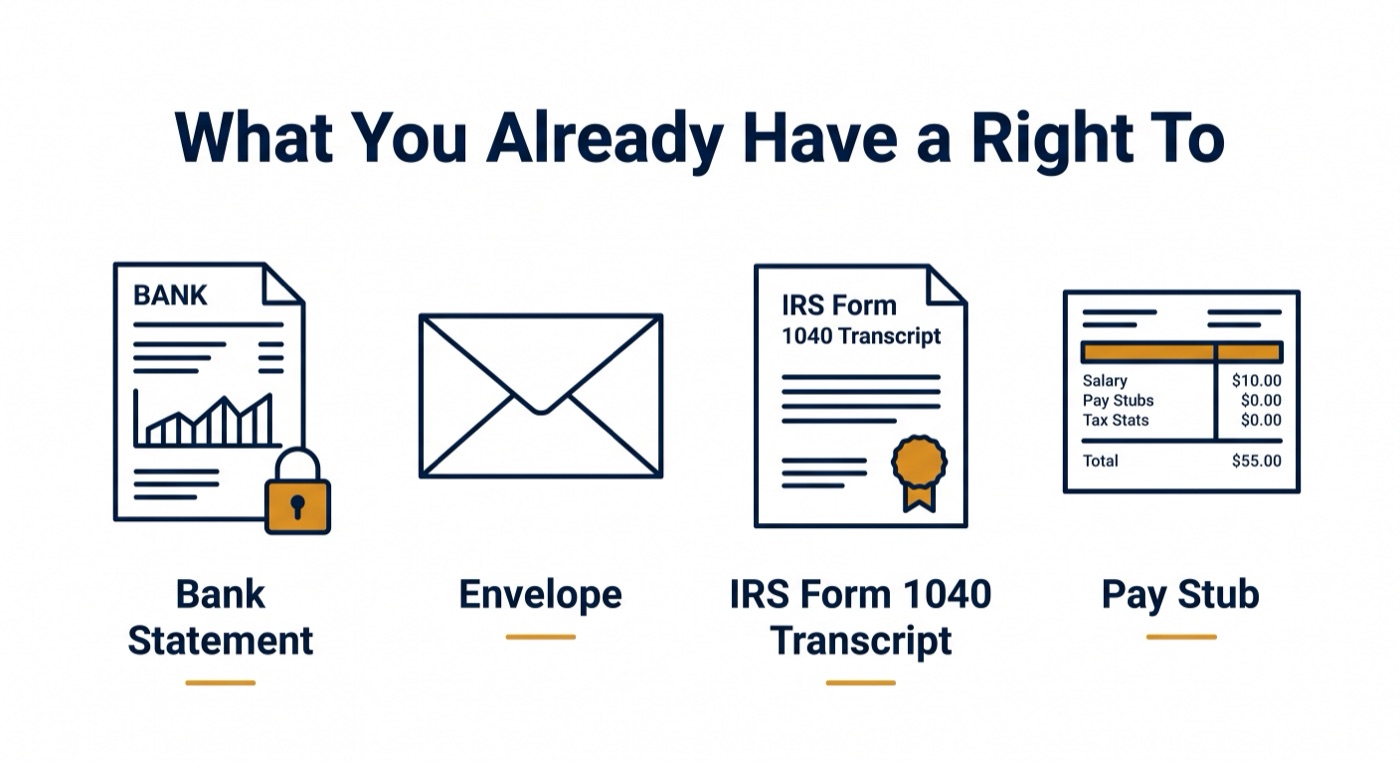
A useful first step is gathering financial information that is already lawfully available to you. Depending on your circumstances, that may include:
- Joint and Individual Accounts: Statements for checking and savings accounts, lines of credit, and credit cards where you are listed as an account holder.
- Income and Benefit Records: Your W-2s, 1099s, pay stubs, retirement account balances, HSA histories, and deferred compensation summaries.
- Household Mail: Statements and correspondence addressed to you individually or jointly with your spouse. Mail addressed only to your spouse should be left unopened.
- Public Real Estate Records: Deeds, mortgages, and county tax assessments available through public records.
- Insurance Policies: Homeowners, umbrella, and auto insurance declarations may provide useful information about insured property and other assets.
These records may not provide the complete financial picture, but they can establish a useful starting point and help identify additional questions for your attorney or financial professional.
A Free Resource Many People Overlook
If you signed a joint tax return, IRS transcripts may provide another useful source of financial information. They are available at no cost through your online IRS account.
Different transcripts provide different types of information.
A Wage and Income Transcript contains information returns filed under your Social Security number, including W-2s and certain Forms 1099, 1098, and 5498.
Depending on the forms filed, the transcript may provide information about wages, interest, dividends, brokerage transactions, retirement distributions, mortgages, IRAs, and HSAs.
A Tax Return Transcript reflects information from the return as filed.
Unlike the Wage and Income Transcript, which reports information associated with an individual taxpayer, a joint Tax Return Transcript reflects information reported on the joint return.
It can provide information about income, business activity, capital gains, retirement distributions, partnership or S corporation income, and other items appearing on the return.
An Account Transcript provides information about activity associated with the tax account, including filing status, adjusted gross income, estimated tax payments, extensions, balances paid, and refunds.
These details can sometimes help identify additional questions. For example, estimated tax payments may warrant further inquiry into sources of income, while a refund may prompt a review of where those funds were deposited.

Looking at the Information Together
Tax transcripts can become particularly useful when reviewed alongside tax returns, bank statements, brokerage records, and other financial documents.
No single document necessarily provides the entire financial picture.
Instead, each record can serve as another piece of the financial history. Comparing information across multiple sources may identify accounts, transactions, income sources, or inconsistencies that deserve additional attention.
For example, differences between information appearing on a joint tax return and information reported under an individual taxpayer's Social Security number may help identify additional sources that should be explored.
These observations can then help an attorney determine whether additional records should be requested through the discovery process.

Stay Within the Appropriate Boundaries
While gathering financial information can be helpful, it is equally important to obtain it appropriately.
Only access accounts on which you are an authorized account holder and use your own credentials. Do not access an account held solely in your spouse's name or use credentials that you are not authorized to use.
Improperly accessing another person's financial information can create legal and evidentiary issues. When records are not available to you directly, your attorney can advise you about appropriate discovery procedures for obtaining them.
The goal is simple: gather what is lawfully available to you and allow the legal process to obtain what is not.
Missing Information Can Still Be Useful Information
When a spouse has had limited involvement in the household finances, incomplete records are common. That does not mean the financial analysis has reached a dead end.
Identifying what is missing can itself be useful.

For example, if available records show regular transfers to an account for which statements have not been produced, that may provide counsel with a specific account or institution to investigate further.
Similarly, documenting a series of transfers to an unfamiliar account or entity can create a financial trail that warrants additional inquiry.
This is one area where organized financial analysis can be particularly helpful. Rather than beginning with a conclusion that assets or income have been concealed, the analysis can focus on the records themselves: what came in, what went out, where it went, and what documentation remains unavailable.
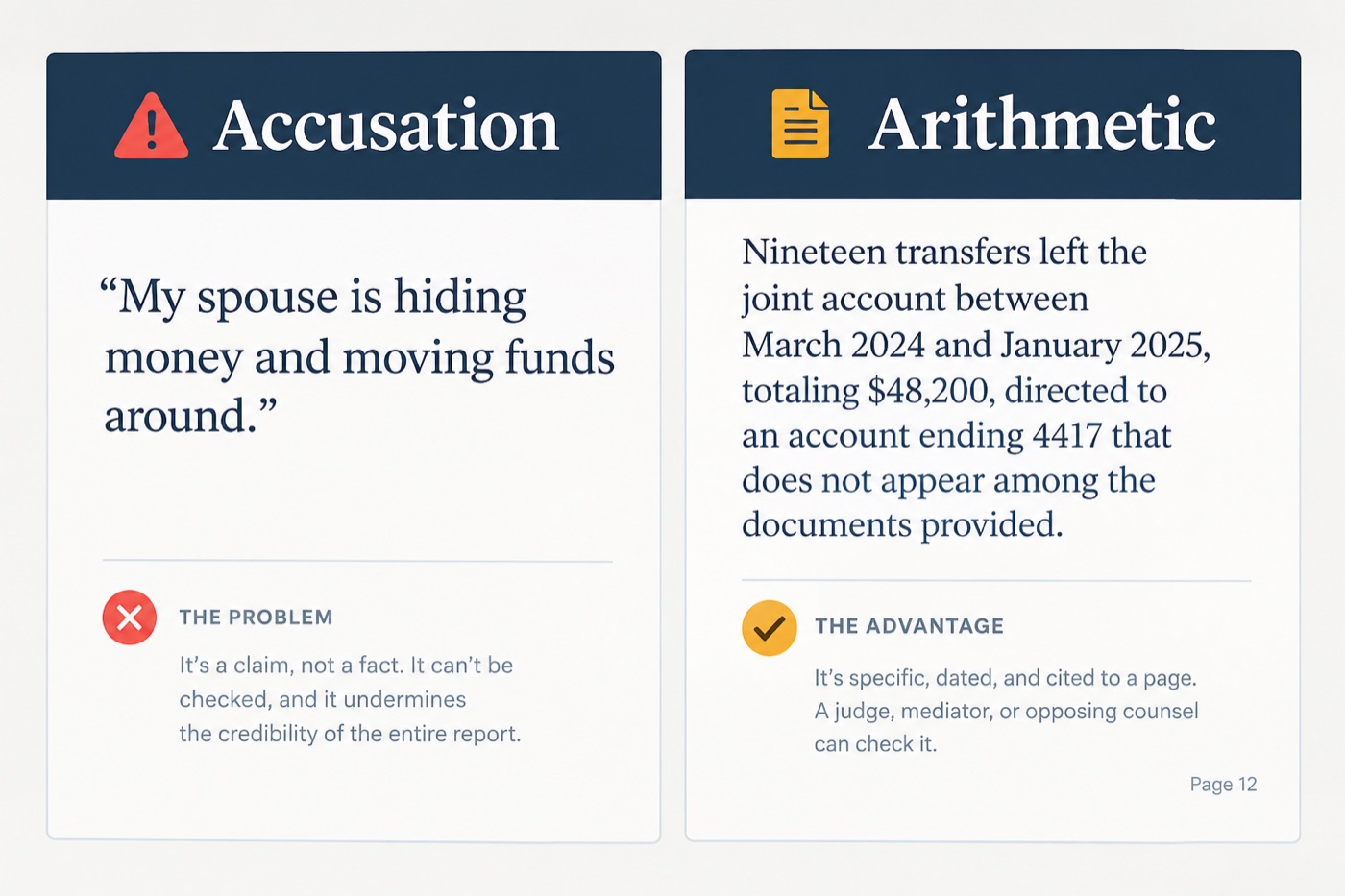
That fact-based approach can help attorneys develop more targeted document requests, subpoenas, and deposition questions.
Know When Additional Expertise May Help
Preliminary financial analysis can provide a valuable starting point, but some matters require more specialized expertise.
A forensic accountant may become particularly helpful when the case involves complex asset tracing, multiple businesses or entities, significant investment activity, complicated compensation arrangements, disputed income, separate and marital property issues, lifestyle analysis, business valuation, or the need for expert testimony.
The timing of that involvement will depend on the case.
In some matters, a preliminary assessment can help narrow the issues before additional professionals are retained. In others, involving a forensic accountant early can help shape discovery, identify missing records, preserve relevant financial information, and avoid duplicating work later.
These resources can complement one another. The important question is not whether one approach is universally better, but what level of analysis is appropriate for the financial issues presented.
Safety Comes First
Financial control can sometimes exist alongside other forms of domestic abuse. If obtaining or reviewing financial records could create a safety concern, personal safety should take priority.
Do not search for documents or retrieve financial information if doing so could place you at risk. Consider working from a secure device, speaking with your attorney, and using formal discovery procedures to obtain information directly from financial institutions when appropriate.
The National Domestic Violence Hotline is available at 800-799-7233, or by texting START to 88788.
Finding the Right Starting Point
Understanding marital finances does not always have to begin with the most extensive level of analysis. For some clients, a targeted or fixed-fee assessment of records already available can provide a practical starting point.
An initial assessment can help organize the financial picture, map accounts and transactions, identify potential gaps, and highlight questions that may require further investigation. The resulting financial summary can give the client and family law attorney a clearer understanding of what is known, what may still be missing, and where additional resources may be useful.

From there, the attorney and client can determine the appropriate next steps. Those may include additional document requests, formal discovery, subpoenas, further financial analysis, or engagement of a forensic accountant for more complex issues.
Illuminate Risk offers one such resource: a fixed-fee assessment designed to help organize available financial information and provide a starting point for additional analysis when needed.
The different resources available in a divorce do not need to compete with one another. Attorneys, targeted financial assessments, forensic accountants, valuation professionals, and other specialists can each serve different roles depending on the issues and stage of the matter.
Ultimately, a clearer understanding of the financial picture can help clients and their attorneys ask better questions, identify appropriate next steps, and make more effective use of the professional resources available to them.
This article provides general information about financial documents and analysis and is not legal advice. Family law rules regarding discovery, marital property, privacy, and access to financial information vary by jurisdiction. Consult with your attorney regarding the rules applicable to your circumstances.